
Over the past five weeks, we have considered several ways in which profits may be extracted from an owner-managed company, including salary, dividends, pension contributions, Director's Loan Accounts and bonuses.
This week, we turn to another part of remuneration planning: Benefits in Kind, often referred to as BIKs.
A company can provide value to a director or employee without paying additional cash. Company cars, private medical insurance, mobile phones and other benefits can all form part of a remuneration package. Some benefits are exempt from tax; others create an Income Tax charge for the individual and National Insurance and reporting obligations for the company.
For owner-managed companies, the key question is therefore not simply whether the company can pay for something, but whether providing it through the company produces a sensible overall tax and commercial result.
A Benefit in Kind is, broadly, a non-cash benefit provided by an employer to an employee or director. Instead of receiving additional salary or a cash bonus, the individual receives an asset, service, facility or other benefit from the company.
Common examples include:
The tax treatment depends on the particular benefit, how it is provided, whether private use is permitted, the amount paid by the individual and whether a statutory exemption applies.
Many Benefits in Kind are treated as taxable employment income. The employee or director is generally charged to Income Tax on the taxable value of the benefit at their marginal rate, while the company will often pay employer Class 1A National Insurance contributions. For 2026/27, the Class 1A rate is 15%.
The taxable value is not necessarily the amount the company paid. Company cars, beneficial loans and living accommodation, for example, have their own statutory valuation rules.
The company should also consider the corporation tax and VAT treatment of the expenditure and, where relevant, capital allowances. These factors can materially affect whether a benefit is genuinely tax-efficient as part of a wider profit extraction strategy.
A company pays an annual private medical insurance premium of £1,200 for a director. The company arranges and pays for the policy directly.
The premium is normally treated as a taxable Benefit in Kind. Therefore:
The company’s total direct cost is therefore £1,380. This expenditure will generally be deductible for Corporation Tax purposes, provided it forms part of the director’s remuneration package.
However, paying for the insurance through the company does not make it tax-free. The director must personally pay the £480 Income Tax arising from the benefit. If the company also pays that tax, the payment would normally create an additional taxable benefit and further tax liabilities.
Hence, paying for private medical insurance through the company allows the company to claim Corporation Tax relief on the premium and associated Class 1A NIC, but it also creates a personal Income Tax liability for the director. The relevant comparison is therefore not simply whether the company can deduct the premium: the director must also consider the Benefit in Kind tax when deciding whether it is more tax-efficient for the company to provide the insurance or for the director to pay for it personally from already-taxed income. Nevertheless, company-funded insurance may still be commercially and financially attractive, particularly where it avoids the need to extract additional salary or dividends to pay the premium personally.
A company is considering providing a director with either a petrol car or a fully electric vehicle. If a company car is made available to a director or employee for private use, including travel between home and a permanent workplace, this gives rise to a taxable Benefit in Kind.
The taxable benefit is calculated by multiplying the car’s relevant list price, broadly, its manufacturer’s list price, including VAT and taxable accessories, by the applicable Benefit in Kind percentage:
Relevant list price × Benefit in Kind percentage = taxable benefit
The Benefit in Kind percentage is not the rate of tax paid by the director. It is the percentage used to determine how much of the car’s value is treated as taxable employment income each year. The applicable percentage is set by legislation and is primarily based on the car’s CO₂ emissions. The Government applies lower percentages to lower-emission vehicles to encourage the use of cleaner company cars.
For illustration, assume that both cars have a relevant list price of £40,000. Also assume that the petrol car has an applicable Benefit in Kind percentage of 25%. This 25% is illustrative only: the actual percentage would need to be determined by reference to the particular vehicle’s officially recorded CO₂ emissions and other relevant characteristics.
The £40,000 purchase price remains a cost borne by the company and is separate from the Benefit in Kind calculation. This allows the £40,000 expenditure to be deducted when calculating the company’s taxable profits, thereby reducing its Corporation Tax liability.
For 2026/27, the statutory Benefit in Kind percentage for a fully electric car producing zero CO₂ emissions is 4%. The 4% is not an assumed tax rate or a percentage chosen by the company; it is the percentage prescribed by legislation for zero-emission company cars for that tax year.
The electric car therefore produces a taxable benefit of £1,600:
£40,000 × 4% = £1,600
The £1,600 is treated as additional taxable employment income received by the director. If the director is a higher-rate taxpayer, the Income Tax charge is:
£1,600 × 40% = £640
The company must also pay Class 1A National Insurance contributions at 15% on the taxable benefit:
£1,600 × 15% = £240
By comparison, using the assumed 25% Benefit in Kind percentage, the petrol car produces a taxable benefit of £10,000:
£40,000 × 25% = £10,000
For a higher-rate taxpayer, the corresponding Income Tax charge is:
£10,000 × 40% = £4,000
The company’s Class 1A National Insurance liability is:
£10,000 × 15% = £1,500
The Benefit in Kind comparison can therefore be summarised as follows:
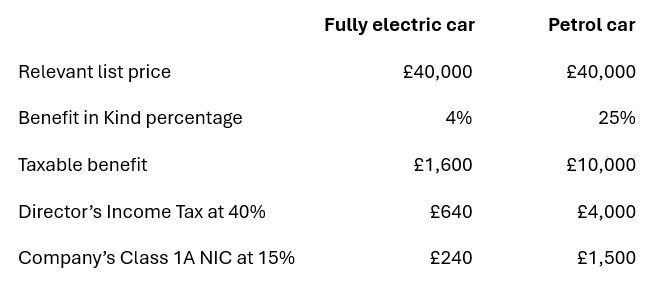
This comparison demonstrates why fully electric company cars can remain attractive as part of a remuneration package. The low 4% percentage substantially reduces both the director’s Income Tax liability and the company’s Class 1A National Insurance liability.
The precise Benefit in Kind percentage for a petrol or hybrid car must be calculated by reference to the particular vehicle.
The Benefit in Kind charge is only one element of the overall comparison. The company should also consider the purchase or leasing costs, insurance, maintenance, charging or fuel costs, the applicable capital allowances, the VAT treatment and the tax consequences of any subsequent disposal of the vehicle.
A director borrows £50,000 from the company and pays no interest.
Where an employment-related loan exceeds the relevant exemption and is interest-free or carries interest below HMRC's official rate, the difference can give rise to a taxable Benefit in Kind. The official rate is currently 3.75% from 6 April 2026, although it can be reviewed during the tax year.
If the £50,000 remained outstanding for a full year and a 3.75% rate applied throughout, the illustrative benefit would be £1,875. A higher-rate taxpayer would pay £750 of Income Tax and the company would pay £281.25 of Class 1A NIC.
There is an exemption for certain small loans where the combined outstanding balance does not exceed £10,000 at any point in the tax year. Other exemptions can also apply in specific circumstances.
A director-shareholder must also consider the separate close company loan rules. A charge under section 455 of the Corporation Tax Act 2010 may arise where a loan to a participator remains outstanding after the relevant repayment deadline. The Benefit in Kind rules and the section 455 rules are separate and both may therefore need to be considered.
Mobile phones are a useful example of how the way a benefit is structured can change the tax treatment.
Where the company provides one mobile phone to an employee or director and retains ownership of the phone, the statutory exemption can apply, including where there is private use.
The result can be different if the director takes out a personal monthly contract and the company simply reimburses the cost. A reimbursement of the employee's own monthly tariff is generally dealt with through payroll and can be subject to PAYE and Class 1 National Insurance rather than qualifying for the employer-provided mobile phone exemption.
The practical lesson is simple: before the company pays or reimburses a personal cost, the arrangement should be checked. Two commercially similar arrangements can have different tax and National Insurance consequences.
There is no general rule that a Benefit in Kind is more tax-efficient than salary. The result depends heavily on the benefit.
Additional salary is straightforward but can attract Income Tax, employee National Insurance and employer National Insurance. A taxable Benefit in Kind may avoid employee Class 1 NIC in many cases, but can still produce Income Tax for the individual and Class 1A NIC for the employer. Some benefits, on the other hand, are wholly or partly exempt and may be considerably more efficient.
For an owner-managed company, the appropriate comparison should therefore consider the entire position: the value received by the director, personal tax, employer National Insurance, corporation tax relief, VAT and the commercial purpose of the expenditure.
Taxable benefits must be dealt with correctly through the employer's reporting arrangements. Depending on the benefit and the arrangements in place, it may currently be reported on form P11D or taxed through payroll.
The reporting system is changing. From April 2027, mandatory payrolling is due to apply to company cars, car fuel, vans and van fuel, and employer-provided medical benefits. From April 2028, mandatory payrolling is expected to extend to most remaining Benefits in Kind. The timing for mandatory payrolling of employer-provided loans and accommodation is to be confirmed.
Businesses providing benefits should therefore review their payroll systems and processes ahead of the new rules.
Common mistakes include:
Benefits in Kind can be a valuable part of a remuneration package, but they should be considered before the company enters into the arrangement, not after the cost has already been incurred.
For owner-managed businesses in particular, remuneration may involve a combination of salary, dividends, pension contributions, bonuses, Director's Loan Accounts and selected Benefits in Kind. The most tax-efficient combination will depend on the company's profits and cash position, the director's personal circumstances and the commercial objective behind the payment or benefit.
A benefit should therefore be selected because it makes sense as part of the overall remuneration strategy, rather than simply because it can be paid through the company.
Benefits in Kind can provide genuine value to directors and employees and, in the right circumstances, can form an efficient part of a wider profit extraction strategy. Electric company cars and employer-provided mobile phones are good examples of benefits that can receive relatively favourable treatment when structured correctly.
However, the rules vary significantly between benefits. Private fuel, beneficial loans and personal expenses can create tax charges that are much higher than expected. The overall position should therefore be reviewed before a benefit is introduced, taking account of Income Tax, National Insurance, corporation tax, VAT, reporting requirements and the commercial rationale.
Used carefully, Benefits in Kind can complement other forms of remuneration. Used without planning, they can create unnecessary tax costs and compliance issues.
In the final article in our Profit Extraction Series, we will consider how remuneration and profit extraction decisions can affect the future sale of a business, including Business Asset Disposal Relief, succession planning, share sales versus asset sales and strategies for maximising value on exit.