
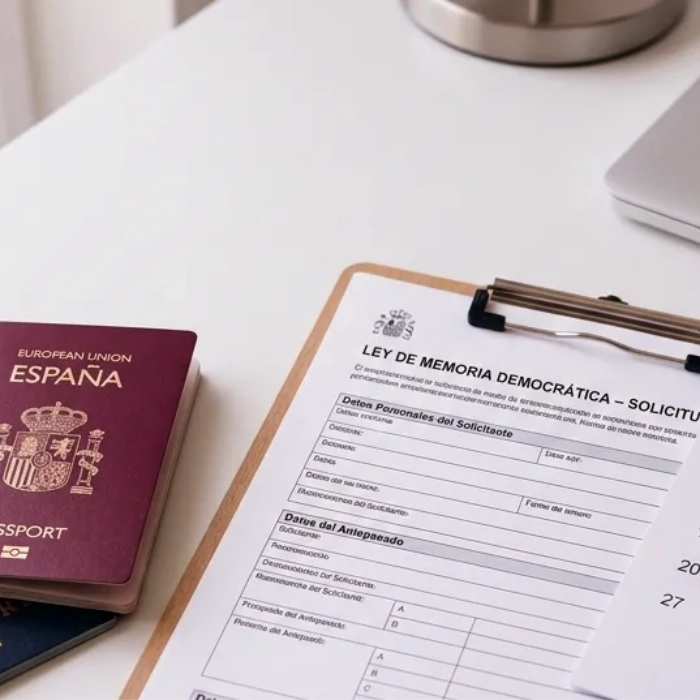
The Ley de Memoria Democrática (Democratic Memory Law) represented an important opportunity for thousands of descendants of Spaniards around the world to recover their connection with Spain and acquire Spanish nationality.
However, not every family member was able to apply before the deadline. Many adult children of applicants who successfully obtained Spanish nationality under the Law were unable to complete their own nationality application in time.
For this specific group of people, there may still be an alternative route to reside in Spain.
If your parent successfully applied for Spanish nationality under the Democratic Memory Law and obtained Spanish nationality as a Spanish citizen of origin, you may be able to apply for a 5 year residence permit in Spain as the child of a Spanish citizen of origin under Article 94.1.h of the Reglamento de Extranjería.
Unlike other residence routes, this authorisation is not based on economic dependency or cohabitation. The legal basis is the family relationship itself i.e. the applicant’s status as the child of a person who is or has been Spanish of origin.
This route may be relevant if:
Spanish nationality law distinguishes between different ways of acquiring nationality, and not all carry the same legal consequences.
Many beneficiaries of the Ley de Memoria Democrática acquired Spanish nationality as Spanish nationals of origin. This distinction is important because Article 94.1.h of the Reglamento de Extranjería specifically refers to children of persons who are or have been Spanish of origin. Confirming this status is therefore an essential first step.
No. This residence route requires neither economic dependency on the Spanish parent nor cohabitation with them. The legal basis is the family relationship itself.
No. The Spanish parent does not need to be resident in Spain. The possibility of applying is linked to the applicant being the child of a person who is or has been Spanish of origin, rather than to the parent’s current place of residence.
This can be particularly relevant for families where the Spanish parent continues living outside Spain, but the adult child wishes to establish their residence in Spain.
Not necessarily. The nationality application period under the Ley de Memoria Democrática has ended. However, if your parent obtained Spanish nationality under this law as a Spanish citizen of origin, you may have a different route available: a residence authorisation under Article 94.1.h of the Reglamento de Extranjería.
No. The fact that your parent obtained Spanish nationality under the Ley de Memoria Democrática does not automatically mean that every child will qualify.
Each case must be assessed individually. The key points to consider are:
Obtaining residence in Spain does not automatically grant Spanish nationality.
However, lawful residence in Spain may be relevant when considering future nationality options, depending on your personal circumstances, nationality, and the period of residence required by Spanish nationality law.
The intersection between Spanish nationality obtained under the Ley de Memoria Democrática and the right to residence under Spanish immigration law can be complex.
The key issue is not simply whether your parent became Spanish, but the legal status of that Spanish nationality and whether your circumstances fall within Article 94.1.h of the Reglamento de Extranjería.
A careful assessment before applying can help ensure that the correct route is chosen and that the application is supported with the appropriate evidence.
This article provides general information about the residence route available under Article 94.1.h of the Reglamento de Extranjería. Immigration and nationality matters depend on the individual circumstances of each applicant. Every case must be assessed individually, as eligibility depends on the circumstances of the parent’s acquisition of Spanish nationality and the applicant’s personal situation.
This information does not constitute legal advice. A personalised assessment should be carried out before submitting any application.